Making plans is easy. Executing plans is another story!
New Year's resolutions... who doesn't know them? And who has never made one?
And more importantly, how many of those resolutions are actually carried out?
We call corporate resolutions Strategic Plans. Long-term plans at a high abstract level. And, if done properly, the plans are executed after the definition phase: Strategy Execution. But just as with small resolutions on a personal level, companies struggle the most to bring these plans to fruition.
Where do things often go wrong? What can we do about it?
And what is the link between strategy and the excellent execution of projects (instead of merely delivering project output)?
Let's first look at the elements of Strategy and Strategy Execution. Gartner provides the following definition, which I find clear and fitting:
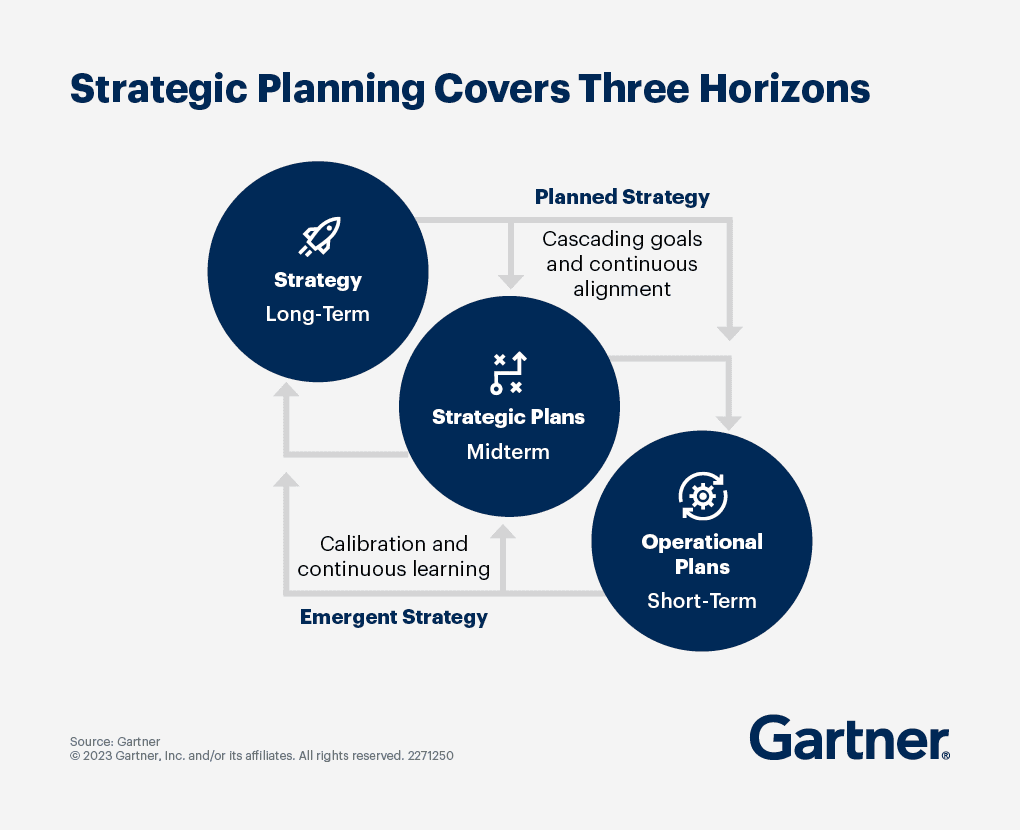
Strategic Plans = Project Portfolio Planning
The 'Midterm' plans, if well developed and made executable, should result in a portfolio of projects. These projects need to be adequately staffed and executed in a clear manner. The intention is for these projects to deliver operational improvements or achieve specific objectives at a tactical level. It is important that, in addition to project progress reports, there is a close examination of the intended (business) goals. Think of dashboards that monitor the objectives. It may happen that everything goes according to plan with the execution of the project, but the output is not what the business, the operation, needs.
For example, if the goal is to increase revenue by 20%, specific actions will need to take place that are different from before. These specific actions that need to be arranged to achieve that growth are often projects that facilitate changes in processes, organization, marketing, or sales. The dashboard would then have the goal (target or key objective) that, for instance, a growth of 2% should occur in the first few months, then 5%, etc., until the targeted growth of 20% is achieved by the end of the year..
If the dashboard shows that the planned growth is not being achieved after the first few months, then adjustments need to be made. This may mean that the project execution changes, for example, becoming more intensive. So if growth targets are not met with 2 marketing events per month, it may be necessary to scale up to 1 per week. Alternatively, other actions may need to be taken that were not described in the original project scope. This can also impact the budget and staffing of these projects. Essentially, we are managing projects in a more 'agile' way.
And we often see in practice that plans are made, projects are set up, but the operational objectives dashboards are not present to achieve the actual intended strategic goals. (at least not on a monthly basis, only at the final goal!).
Strategy Execution = Project Execution + Objectives Dashboards
The biggest challenges in strategy execution are, according to some experts:
- Bridging the gap between devising and executing the strategy
- Adapting to the changing and disruptive environment
- Mobilizing and motivating the people and resources needed for the execution
- Managing the complexity and uncertainty associated with execution
- Measuring and improving the results and the impact of the execution
- Creating a culture of continuous improvement, renewal, and innovation
1: Strategy Execution: From the Why to the How - Boom Management 2: Strategy Execution: From the why to the how - Boom Management 2 : Strategy execution is the number 1 challenge - Boom Management
Completely in line with our observations, Gartner has identified the three key challenges of Strategy Execution that actually fail at project execution:
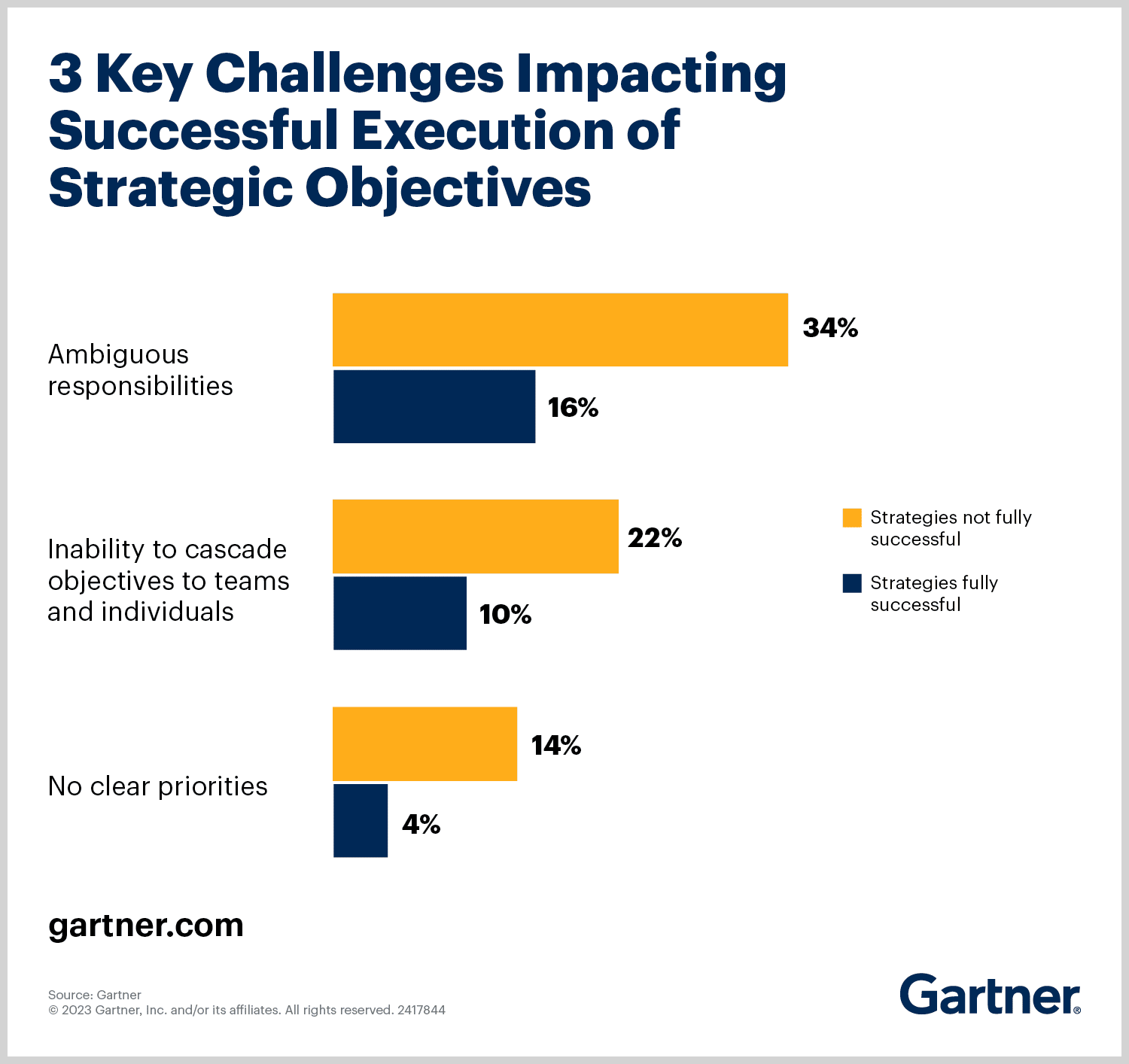
Fortunately, these three challenges are much less of a problem for organizations with a mature PMO (Project Management Office). A PMO where Project Portfolio Management is clearly practiced, and where priorities are by definition set between and within projects. A PMO that has established a Way of Working (WoW) that leaves little room for misinterpretation of the responsibilities of teams and individual team members (particularly in hybrid project organizations, there are additional dangers here which we will discuss in a subsequent blog).
The inability to communicate objectives to teams and individuals is, however, a very interesting and complex challenge. This inability stems from the fact that objectives are often set at a high level of abstraction and are almost never made SMART:
- Specific,
- Measurable,
- Acceptable,
- Realistic, and
- Time-bound.
I have given training sessions where we do SMART exercises. It is really harder than you would think!
The most important aspect of Strategy Execution
Assuming that the PMO (with our help 😊) is well set up and the teams are well trained and have grasped the WoW, success is still not guaranteed. Because the most important element of Strategy Execution is to have good steering: not whether projects achieve their output, but whether they facilitate the business outcome! In the FUCA world we live in, projects must be continuously adjusted.
(FUCA world is a variant of VUCA world, a term originally used by the U.S. military to describe the situation after the Cold War. VUCA stands for Volatile, Uncertain, Complex, and Ambiguous, which translates to Volatiel, Onzeker, Complex, and Ambigu in Dutch.)
In short: ensure operational dashboards are updated monthly to see the impact of the changes being implemented through projects. It is also a good idea to create a central dashboard where all strategic goals are developed according to the OKR methodology, allowing the (Business) Objectives to be concretely measured by the definition of 'Key Results.'.
Een OKR bestaat uit twee delen: een Objective en één of meer Key Results. Een Objective is wat je wilt bereiken, bijvoorbeeld het vergroten van de klanttevredenheid, het verhogen van de omzet, of het verbeteren van de kwaliteit. A Key Result makes it possible to measure whether you have achieved your Goals / Objective(s), for example, the number of surveys, the growth percentage, or the number of errorsAn example of an OKR is:
- Objective: Increase our users' engagement
- Key Results:
- Reach 10,000 daily active users on our app
- Increase the average session duration from 5 to 10 minutes
- Reduce the failure rate from 20% to 10%
OKRs are intended to help you set ambitious and inspiring goals that you can also achieve with your team.OKRs were originally conceived by Andy Grove at Intel and later popularized by John Doerr at Google. Since then, OKRs have been used by many successful organizations, such as Netflix, Spotify, and LinkedInStrategy Execution control
To gain and maintain full control over Strategy Execution, it is essential to have an excellent PMO in place, equipped with sound Project Portfolio and Project Management methodologies and approaches, plus the availability of high-quality SMART dashboards with OKRs .
Our Project Portfolio Management Tooling, together with dashboards created in or from spreadsheets, accounting software, CRMs, PowerBI, ERP solutions, etc., ensures success. That is, provided the governance within the organization is properly established and these dashboards are reviewed at all levels at least once a month!
If setup, drafting the correct OKRs, and real-time tracking still present a challenge, the consultants at The PMO Company can provide excellent advice and support. We offer various PPM tools and extensive experience in building valuable dashboards.
Another option is to step into the world of Strategy Execution tooling together with us. These are solutions that capture strategic plans, projects with activities, and OKRs, as well as share them interactively with the team, including real-time reporting (also from various data sources and solutions).
Examples of Strategy Execution solutions include Cascade , Rythm , Perdoo, i-nexus, etc.Cascade, Rythm, Perdoo, i-nexus, Planview etc. And let's not forget: the Dutch Xeleron!
Happy Planning!
-/-